
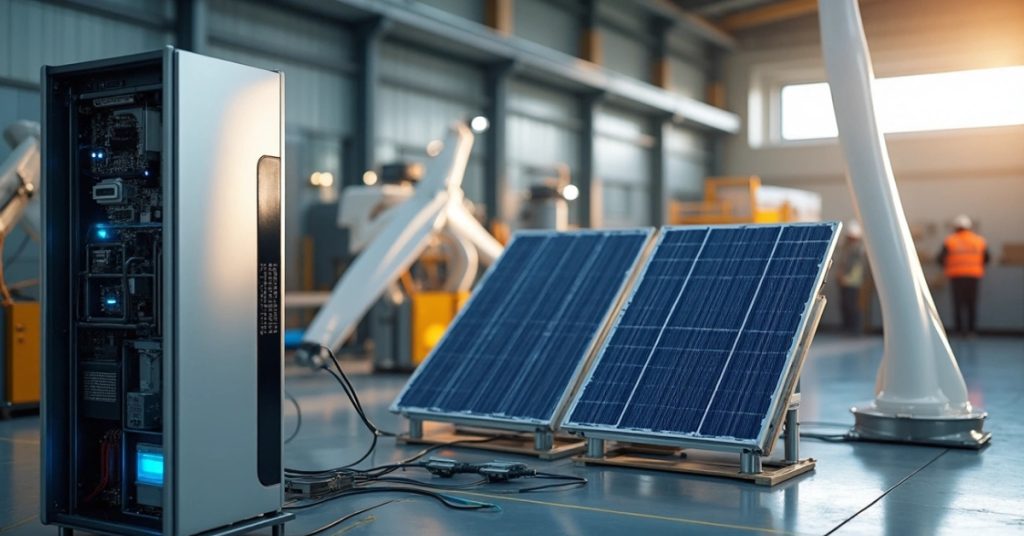
The investment boom in renewable energy semiconductors and electronic components has reached unprecedented levels. Clean manufacturing investments have more than tripled from $2.5 billion in Q3 2022 to $14.0 billion in Q1 2026. These numbers represent more than just growth—they signal a complete reshape of the industry.
Global energy priorities have changed radically. Clean energy investments now almost double those in fossil fuels. Companies have launched 380 clean technology manufacturing facilities since August 2022. Renewables will power more than a third of the world’s electricity by 2026. This rapid expansion creates substantial requirements for specialized electronic components.
The EV sector showcases this remarkable expansion. The Clean Investment Monitor currently tracks 79 operational EV manufacturing projects that can produce 2.58 million EVs annually. US production capacity could reach 6.84 million vehicles by 2035 when announced and under-construction facilities become operational. This number equals 60-67% of projected annual ZEV sales between 2030 and 2035.
Let’s get into the essential electronic components that power both renewable energy and EV advances. We’ll explore their rising demand and how supply chain dynamics could shape the industry’s future.
Battery Cells and Modules
Battery technology powers today’s renewable energy and EV revolution. These power systems work in a hierarchical structure that improves both performance and safety.
Battery cells and modules key features
The electrochemical cell stands as the smallest yet most vital component in any battery system. These cells have three major parts: a cathode (positive electrode), an anode (negative electrode), and an electrolyte that helps ions flow between them. Lithium ions move from the anode to the cathode through the electrolyte when discharging, which creates electrical current.
Today’s EV market features three main cell formats:
- Cylindrical cells: Tesla made these cells popular because they offer high mechanical stability and efficient heat dissipation. Their 20-year-old manufacturing processes lead to consistent quality and lower costs. Panasonic, LG Chem, and Samsung SDI lead the production.
- Prismatic cells: These rectangular-shaped cells make the best use of space in battery packs. Their sturdy housing protects against physical damage and provides structural strength. BMW and Audi’s EV models now use prismatic cells.
- Pouch cells: These cells come with a flexible, lightweight design that opens up creative battery pack layouts. GM and Hyundai utilize these cells’ adaptability to improve their EV designs. Without rigid casing, they weigh much less.
Battery types differ most in their cathode chemistry, which affects both performance and cost. Popular formulations include nickel manganese cobalt (NMC), lithium iron phosphate (LFP), and versions with aluminum or other metals. Graphite makes up most anodes, but silicon-based alternatives could store more energy.
A module forms when multiple cells sit in a case with attached terminals. Recent estimates show the module stage takes up 11% of a finished lithium-ion battery pack’s total cost. Different manufacturers use varying numbers of cells per module. Envision AESC puts four cells in Nissan Leaf modules, while Samsung SDI uses 12 cells.
Battery packs serve as complete power units for EVs. They combine multiple modules with electrical connections, thermal management systems, and protective covers. This final assembly takes 7% of a lithium-ion battery pack’s total cost.
Battery cells and modules why it’s in demand
Electric vehicles and renewable energy have grown so fast that we just need more advanced battery technology. Batteries now power both moving vehicles and store energy from wind and solar sources.
Cell chemistry keeps changing for several reasons. Manufacturers want higher energy density so EVs can drive further on one charge. They also want lower costs and diverse supply chains, which has created interest in different chemical makeups.
NMC chemistries pack the most energy and now use more nickel with NMC 811 and NMC 9 replacing older NMC 111/523 versions. More nickel means less cobalt, which costs more and comes from questionable mining practices in limited locations.
LFP batteries have made a comeback despite storing less energy. They cost less and don’t rely on rare materials, which makes sense for cheaper and mid-range EVs. Chinese manufacturers love LFP technology, and most Chinese EVs now run on these batteries.
Battery module designs keep getting better. Manufacturers use fewer packaging materials, so active cells take up more space and weight in each pack. Some companies now skip modules entirely with cell-to-pack designs that group cells directly. This new approach packs more energy into each battery.
Battery cells and modules supply chain status
Chinese, South Korean, and Japanese companies rule the global battery market. Together, they made up nearly 70% of battery production in 2021. China’s CATL led with 33%, followed by South Korea’s LG Energy Solution at 22%, and Japan’s Panasonic at 15%.
Global battery cell production grew by almost 30% in 2024, reaching over 3 TWh—triple the combined demand for EVs and battery storage that year. China hosts 85% of this production capacity, unchanged from 2023, and Chinese producers own over 75%.
The US battery industry grew by almost 50% in 2024. Korean companies, attracted by tax breaks, drove this growth. This expansion pushed US capacity past the European Union’s, though EU capacity still grew by 10% despite setbacks like the Northvolt plant bankruptcy in Sweden.
China dominates the active materials supply chain even more. They make about 90% of anodes and lithium electrolyte solutions. The country also produces 70% of cathodes, 74% of separators, 82% of electrolytes, and 85% of anodes worldwide. Japan makes 14% of cathodes, 11% of anodes, 31% of separators, and 19% of electrode solutions. South Korea produces 15% of global cathodes and 3% of anodes.
The future looks promising. If all planned projects succeed, China’s manufacturing capacity would grow by nearly 60%. The European Union and United States would see their capacity grow four times larger. This growth would push global capacity to about 6.5 TWh by 2030 (up from 3.3 TWh in 2024) and reduce China’s global share from 85% to roughly two-thirds.
The US aims to produce 0.8 million metric tons of cathodes yearly by 2030, but demand will hit 1.3 million metric tons. Domestic anode production will reach about 500,000 metric tons per year, while demand grows to 700,000 metric tons. These gaps mean the US will keep importing cell components for locally made batteries.
Solar PV Modules and Cells
Solar photovoltaic (PV) technology leads the global move toward green practices. PV cells serve as the life-blood technology to decarbonize electricity generation worldwide. These cells rank among the most versatile renewable energy semiconductors.
Solar PV modules and cells key features
The most important performance metric in the industry remains PV cells’ conversion efficiency—the percentage of solar energy that becomes usable electricity. Modern solar cells work at efficiency rates of about 20%. Traditional silicon-based cells typically turn around 22% of absorbed sunlight into power. This efficiency depends on knowing how to capture different wavelengths of light, minimize recombination losses, manage temperature effects, and reduce reflection.
The commercial solar market has two main technologies:
- Crystalline silicon (c-Si) modules: The industry calls it the “workhorse”. C-Si technology makes up more than 90% of global solar panel sales. These modules come in two main types:
- Monocrystalline: Higher efficiency (20-25%) with better space utilization
- Polycrystalline: More affordable but slightly less efficient
- Thin-film modules: These second-generation cells work better in low-light and extreme temperatures than c-Si. They cost less to make because they use less semiconductor material and can be produced at lower temperatures. Their average conversion efficiencies (12-14%) are nowhere near crystalline technology.
Perovskite solar cells mark a breakthrough in technology. These materials respond to different colors in the solar spectrum. Scientists have reached experimental efficiencies of nearly 34% by combining perovskite with silicon in tandem configurations. These results go beyond the theoretical limit of single-junction solar cells.
Solar PV modules and cells why it’s in demand
Several factors drive the rising demand for solar PV technology. Innovation has made it more affordable. Module prices have hit record lows—about USD 0.10/Watt for global spot prices in Q3 2024. The average U.S. module price of USD 0.31/Watt in Q2 2024 showed a 6% quarter-over-quarter drop and 16% year-over-year reduction.
Solar’s applications have grown beyond traditional ground-mounted arrays. New ideas include building-integrated photovoltaics and floating solar systems. Water’s cooling effect helps these systems work 15% better. Scientists have even created flexible perovskite formulations that can be printed onto surfaces or woven into fabrics.
Solar PV will become the world’s main power source before 2050. Annual installation volumes will exceed 43 GW for the rest of the decade. U.S. solar capacity will reach nearly 450 GW by 2029, powering over 71 million homes.
Hybrid systems have gained popularity recently. About 26% of utility-scale PV capacity in 2023 came from hybrid PV/battery energy storage system projects. This shows how well these renewable energy technologies work together.
Solar PV modules and cells supply chain status
China has changed the global solar PV manufacturing landscape in the last decade. They invested over USD 50 billion in new PV supply capacity—ten times more than Europe. This created more than 300,000 manufacturing jobs across the solar PV value chain since 2011. China now controls over 80% of all manufacturing stages (polysilicon, ingots, wafers, cells, and modules).
China’s share of global polysilicon, ingot, and wafer production will soon reach almost 95%, based on manufacturing capacity under construction. China’s Xinjiang province makes 40% of global polysilicon.
The U.S. has expanded its domestic solar manufacturing capacity. They added 9.3 gigawatts of new solar module manufacturing capacity in Q3 2024, bringing the total to nearly 40 GW. U.S. solar module factories can now meet almost all domestic demand.
The Inflation Reduction Act (IRA) helped add over 95 GW of manufacturing capacity across the solar supply chain, including nearly 42 GW of new module capacity. More than 35 new solar factories have opened since the IRA passed. This brought over USD 3 billion in investments and created 9,500 American jobs.
U.S. cell manufacturing has started growing again. ES Foundry became the country’s second domestic cell manufacturer by opening a 1 GW cell factory in South Carolina in January 2026.
The global market stays concentrated among key players. Infolink reports that the top 10 module manufacturers shipped 226 GW in the first half of 2024, showing a 40% year-over-year increase. Four Chinese companies dominated 68.5% of the global c-Si module market in 2023: JinkoSolar (14.7%), Trina Solar (13.7%), LONGi (13.1%), and JA Solar (12.8%).
Wind Turbine Components
Wind turbine systems showcase engineering excellence by combining advanced materials with sophisticated electronics to tap into renewable energy at unprecedented scales. These systems keep evolving faster as the world’s need for clean energy grows.
Wind turbine components key features
A utility-scale wind turbine has about 8,000 individual parts that work together to generate electricity. The simple way a wind turbine controls wind’s kinetic energy and converts it into electrical power involves several key components:
Rotor blades: These massive structures catch wind energy and turn it into rotational motion. Today’s blades can stretch beyond 100 meters (over 300 feet) in length. Each blade is carefully crafted to stay strong and maintain its aerodynamic performance for 20 years. The manufacturing team at Sandia National Laboratories has cut down production time for a single blade by 37% (from 38 to 24 hours).
Towers: These structures hold up the entire turbine and now reach about 94 meters (308 feet) high—similar to the Statue of Liberty. The towers, built mostly from tubular steel, keep getting taller to catch stronger, steadier winds at higher levels.
Nacelle: This housing protects critical operational parts, including the generator, drivetrain, and control systems. The nacelle of a 1.5 MW geared turbine weighs more than 4.5 tons.
Drivetrain: This system moves rotational energy from the blades to the generator. Standard designs use gearboxes that speed up rotation from slow blade movement (usually 5-15 rotations per minute) to higher speeds (1,000-1,800 rotations per minute) needed for electricity generation. Direct-drive systems skip the gearbox but often need permanent magnets with rare earth materials.
Generator: This vital part turns mechanical rotation into electrical current through electromagnetic induction. New superconducting generators can weigh 30% less than traditional designs.
Control systems: Smart electronics watch wind conditions and adjust the turbine’s operation. The pitch system changes blade angles to capture more energy and protect the turbine in high winds. The yaw drive turns the nacelle to keep blades lined up with wind direction.
Wind turbine components why it’s in demand
The shift toward renewable energy has created a big need for wind technology parts. Wind power captured by better turbines is the life-blood of sustainable energy infrastructure. Several factors accelerate industry growth:
Technological advancements: Better turbine designs have boosted efficiency and lowered costs. Designs with longer blades, taller towers, and low-specific-power setups have opened up 80% more wind energy potential this decade. Better blade materials and designs have increased energy capture by 12%.
Offshore expansion: More offshore wind farms have increased the need for specialized parts that can handle marine conditions. These farms benefit from stronger, steadier winds and have fewer land restrictions. Floating wind technology lets us build in deep-water areas where fixed turbines don’t work.
Policy support: Government incentives, tax benefits, and renewable energy goals have helped the market grow. These supportive rules have created growth chances for turbine makers worldwide.
Cost reductions: Technology progress has improved wind power economics. Taller towers and longer blades have made turbines more efficient, even in areas with low wind speeds.
Wind turbine components supply chain status
Wind turbine manufacturing faces both chances and challenges as the industry grows to meet global needs:
Manufacturing capacity: The world can produce 170-180 GW of major wind parts (nacelles, towers, and blades) in 2023. This capacity should grow to about 205 GW for towers, 225 GW for blades, and 260 GW for nacelles soon.
Geographic concentration: China leads manufacturing, making 50-70% of all main wind energy parts. This creates supply chain risks for markets trying to build their own manufacturing.
North American manufacturing: The United States has built a strong supply chain with over 500 manufacturing facilities making wind parts across the country. These factories make blades, towers, generators, and assemble turbines.
Supply chain constraints: Highway heights limit tower sizes, and moving longer blades creates logistical problems. These challenges have led to new manufacturing methods, like on-site tower production using spiral welding and 3D printing.
Critical material dependencies: The industry struggles with parts needing rare earth elements, mainly for permanent magnet generators in direct-drive turbines. Finding alternatives to these magnets could make supply chains more resilient.
Future investments needed: Building stronger domestic supply chains needs more funding for logistics and infrastructure (especially offshore wind ports and vessels), innovation to compete better in manufacturing, and policies that show steady demand.
EV Power Electronics
Power electronics are the hidden champions in electric vehicles. They conduct the complex energy flow between batteries and motors. These smart components convert, control, and manage electrical power throughout the vehicle. This directly affects the vehicle’s efficiency, range, and overall performance.
EV power electronics key features
Every EV contains a complex network of electronic systems that control energy flow. DC-DC converters form the core of power electronics. They change high-voltage battery power into lower DC voltages that vehicle subsystems can use. These converters use state-of-the-art low-loss switching devices like Silicon Carbide (SiC) MOSFETs to cut down energy loss during conversion.
Onboard chargers (OBCs) convert AC power from the grid into DC for battery charging. Modern OBCs work at different levels—Level 1 (120 VAC) and Level 2 (240 VAC)—which determine charging speeds. Many come with communication features that enable smart charging options and user-friendly controls.
DC fast charging stations deliver power straight to the vehicle battery, which reduces charging times to just 15 minutes. This technology makes EVs much more practical for daily use.
Wide-bandgap semiconductor materials lead the most innovative developments in EV power electronics. Silicon Carbide (SiC) rules the global market because it offers higher breakdown voltage, faster switching speed, and lower conduction losses than traditional silicon. Gallium Nitride (GaN) has become more popular due to its high electron mobility and quick switching features.
EV power electronics why it’s in demand
Electric vehicles are becoming more common, which creates a huge need for advanced power electronics. Government regulations now require automakers to build more EVs. This pushes the need for reliable power management systems even higher.
New technology breakthroughs have created more efficient components that improve vehicle range and performance. GaN devices help design smaller, lighter inverters that use battery power better and let vehicles drive further between charges. GaN-based three-level topology in 800-V battery-based traction inverters cuts down switching and high-frequency losses. This makes inverters work better.
D3GaN power switches can reach 99.3% efficiency at a 40 kHz switching frequency. These improvements do more than boost performance—they give users faster charging times and waste less energy during charging.
Wide-bandgap semiconductors make more economic sense as manufacturing grows. GaN power devices save money over an EV’s lifetime by cutting power loss, working more efficiently, and allowing smaller components.
EV power electronics supply chain status
The automotive power electronics field changes faster than ever. Silicon Carbide helps adopt 800V platforms that charge much quicker. Industry experts think GaN will become the top choice for onboard chargers.
Infineon Technologies made big progress in 2024 by developing 300mm power gallium nitride technology. This strengthened their position in the growing GaN market. The advancement will cut costs as full-scale 300mm GaN production reaches cost parity with silicon on RDS(on) level.
The industry will focus on several tech goals through 2026: bigger wafer sizes (especially 300mm GaN), less switching loss, better durability, new power supply designs, and improved materials that work better but cost less to make.
Recent advances solve many old manufacturing problems. Wolfspeed now makes 200mm SiC wafers through vertical integration, though 6-inch SiC chips used to cost too much. This innovation gives better control over epitaxial layer quality for high-voltage devices up to 10 kV.
Power electronics will stay crucial to achieving better efficiency, longer range, and improved charging in future electric vehicles as the renewable energy semiconductor sector grows.
Charging Infrastructure Electronics
Charging infrastructure electronics are the foundations of the electric vehicle’s rise. These advanced systems control power flow from the grid to vehicles through specialized hardware and smart software components.
Charging infrastructure electronics key features
EV charging infrastructure works with three different levels of equipment. Level 1 charging works through standard 120V outlets and adds about 5 miles of range per hour. Level 2 units work faster through 240V circuits and give roughly 25 miles per hour of charging. DC fast charging—also known as Level 3—goes straight to the battery by skipping the vehicle’s onboard charger. This gives 100-200+ miles of range in just 30 minutes.
Different markets use different connector standards. North America uses the J1772 connector as its standard for Level 1 and Level 2 charging. DC fast charging has three main standards: Combined Charging System (CCS), CHAdeMO, and Tesla’s own connector. Tesla has rebranded its connector as the North American Charging Standard or NACS.
Every charging station has these important electronic parts:
- Battery management systems
- Power conversion systems with inverters
- Control software for station management
- Payment processing systems
- Communication interfaces
Modern equipment stands out because of its smart charging features. These stations connect to the internet, which makes remote monitoring, payments, and load management possible. This connection is a game-changer because it lets stations adjust charging patterns based on grid conditions in real time.
Charging infrastructure electronics why it’s in demand
The global EV charging equipment market will grow from $7 billion today to about $100 billion by 2040—growing 15% each year. Government support and changing consumer priorities drive this remarkable growth.
Most people charge at home. Private residences handle 70-90% of charging in many markets. In spite of that, public infrastructure keeps growing faster. Public charging stations worldwide grew by more than 40% in 2023.
Fast chargers grew even more at 55%, which was faster than slower charging units. People want shorter charging times, especially for long trips where range anxiety still stops many from buying EVs.
Charging infrastructure electronics supply chain status
Charge Point Operators (CPOs) will control about 65% of the market’s value by 2040 (around $65 billion). Hardware providers started with 46% market share but will drop to 20% by 2040.
The supply chain faces ongoing challenges. Parts are hard to get, and some power supplies take more than 18 months to arrive. Big semiconductor makers like STMicroelectronics, onsemi, and Analog Devices now make more power semiconductors, silicon carbide chips, and battery management systems to meet growing demand.
Manufacturers now focus more on advanced connection features like Wi-Fi, Bluetooth, and NFC technology. These features make the user’s experience better with faster sign-ins and better reliability.
Conclusion
The electronic components I wrote about in this piece will shape our path toward renewable energy and electric mobility’s future. Battery technology keeps getting better with higher energy density and lower costs. Cell-to-pack designs have improved efficiency by a lot. Solar PV costs have dropped to record lows, making it more available worldwide.
Wind turbine parts present exciting chances and tough challenges, especially when you have logistics and material constraints. China leads most manufacturing areas. Yet, North American and European production capacity is growing as companies realize they need diverse supply chains.
EV power electronics might be changing things the most. Wide-bandgap semiconductors like Silicon Carbide and Gallium Nitride now achieve performance levels that seemed impossible before. These improvements mean EVs can drive farther, charge faster, and give users a better experience.
Charging infrastructure grows fast and adds momentum to the electric shift. Smart charging systems create new ways to work with the power grid. Parts shortages worry manufacturers in these sectors, but production capacity keeps growing to meet the extraordinary market needs.
Manufacturing concentration in specific regions brings risks. Yet, the economic benefits have led to massive investments worldwide. The market for renewable energy and EV parts isn’t just about helping the environment anymore. It makes financial sense whatever your views on climate change.
We’re seeing the start of a big tech shift. These components are the foundations of a cleaner, more sustainable energy system that will last decades. Companies that build reliable supply chains for these key technologies will lead the new energy economy.